
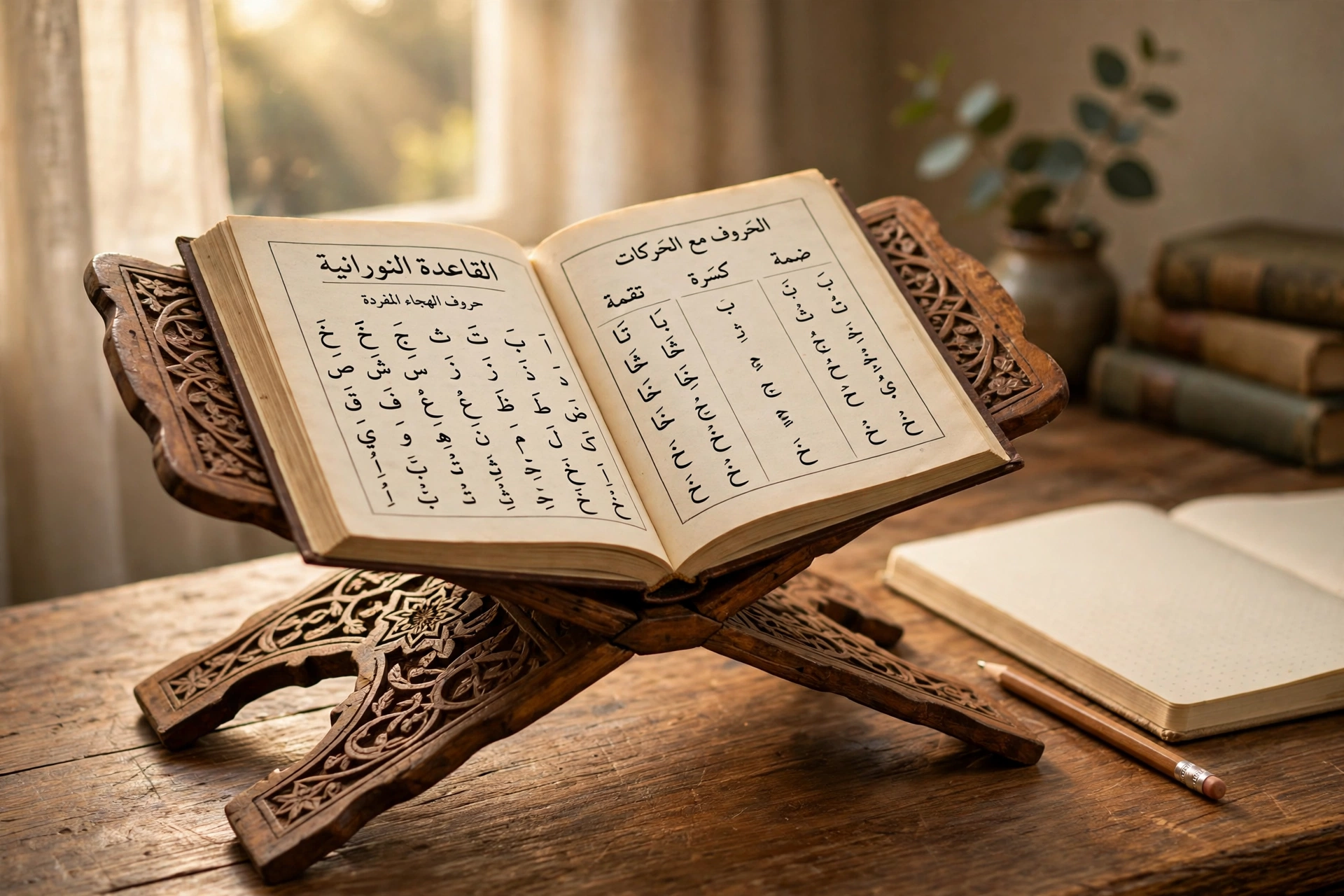

Noorani Qaida is the beginner’s primer that takes a complete beginner from the Arabic letters to reading the Quran — letters, vowels, joining, and the first Tajweed rules, in 17 lessons. If you want to learn to read the Quran and you cannot read a single Arabic letter yet, this is where you start.
Key takeaways
- Noorani Qaida is a step-by-step primer, not a book of the Quran itself — it teaches you how to read.
- It has 17 lessons in a fixed order, from single letters to the first Tajweed rules.
- It is for complete beginners: children aged 4 and up, adults, and new Muslims.
- After the Qaida, you move on to reading the Quran itself (Nazra) with a teacher.
What it is, and who it is for
Noorani Qaida is a small book used to teach complete beginners how to read Quranic Arabic. It is not a copy of the Quran. It is a teaching book: it breaks the skill of reading into small steps, and each step is practised until it is correct before the next one begins.
The Qaida starts with the Arabic letters — their sounds and shapes — and builds up through joining letters into words, adding the vowel marks, and introducing the first rules of correct recitation. By the end of the 17 lessons, a student can read the Quranic script and is ready to begin reading the Quran itself.
It is for anyone who cannot yet read the Quran. That includes children from around age 4, adults who never learned as children, and new Muslims starting from zero. It does not assume any prior knowledge: no Arabic, no memorisation, no earlier study. The first lesson assumes nothing at all.
Mufti Menk’s own Quran journey began this way. He memorised the Quran as a child under his father before going on to formal study in Gujarat and Madinah — sound first, then study. His teaching still follows that order: learn to read and recite correctly first, and let understanding deepen once the reading is in place. It is the same order the Qaida teaches.
Why it is used worldwide
Noorani Qaida is used by Quran teachers and academies in many countries, and it has been used for generations. The reason is simple: the order works. It teaches the letters before the joining, the joining before the vowels, and the vowels before the rules — so a student never meets a step they are not ready for.
Because the lessons are short and the order is fixed, a teacher can tell exactly where a student is, what they have covered, and what comes next. That makes it easy to pick up after a break, to change teacher, or to move between academies without losing your place.
The 17 lessons in brief
The 17 lessons run in a fixed order, and each one assumes the one before it. Here is the shape of the journey.
The early lessons cover the letters themselves: single letters, their sounds and their shapes, then joined letters and the different forms a letter takes at the start, middle and end of a word. These lessons are the foundation — everything else depends on the letters being correct.
The middle lessons add the vowel marks — the small signs above and below the letters that tell you which sound to make — and the joining of letters into words. This is where reading starts to feel real: letters you already know are now words you can read.
The later lessons introduce the marks that change how a letter sounds — the stillness mark (Sukoon), the doubling mark (Shaddah), the doubled vowels (Tanween) — and the long vowels (Madd). The final lessons introduce the first Tajweed rules, so that by the time you finish, you are not only reading but reading with the beginnings of correct recitation.
A fuller lesson-by-lesson breakdown is given in the article “Noorani Qaida Lessons in Order: All 17 Lessons Explained” — and the exact contents of each numbered lesson should be checked against the Qaida text with a qualified teacher.
Who should start with Qaida
If you cannot yet read the Quran, you should start with the Qaida — whatever your age or background.
Children usually start from around age 4, once they can sit for a short session and follow instructions. For a child, the Qaida is taught in short sessions with lots of repetition and praise. Adults start from zero in exactly the same way, and usually move faster because they understand the logic and can practise on their own. New Muslims start here too, because the Qaida assumes no background at all — it teaches reading from the very first letter.
If you can already read a little — perhaps you learned as a child and have forgotten most of it — a teacher will check your level in a trial class and tell you whether to start the Qaida from the beginning or to pick it up partway through. Many returning learners restart the Qaida to fix shaky letters before moving on, and that is a sensible choice, not a step backwards.
What comes after Qaida
After the Qaida, the next stage is Nazra — reading the Quran itself. In Nazra, you read directly from the Mushaf, with a teacher listening and correcting your pronunciation. The reading becomes longer and smoother, and the teacher corrects the small mistakes that the Qaida’s structured lessons could not cover.
After fluent Nazra reading, the path opens up. The usual next steps are Tajweed — the rules of correct recitation — and then studying the meaning of what you read through translation. Some learners also begin memorisation (Hifz) once their reading is fluent. Each stage builds on the one before it, and the Qaida is the foundation all of them stand on.
Skipping the Qaida is a false saving. A learner who jumps straight into reading the Quran without it will stumble over the letters, guess at the vowels, and build habits that take longer to fix than the Qaida itself would have taken.
How to start: trial class and first lesson
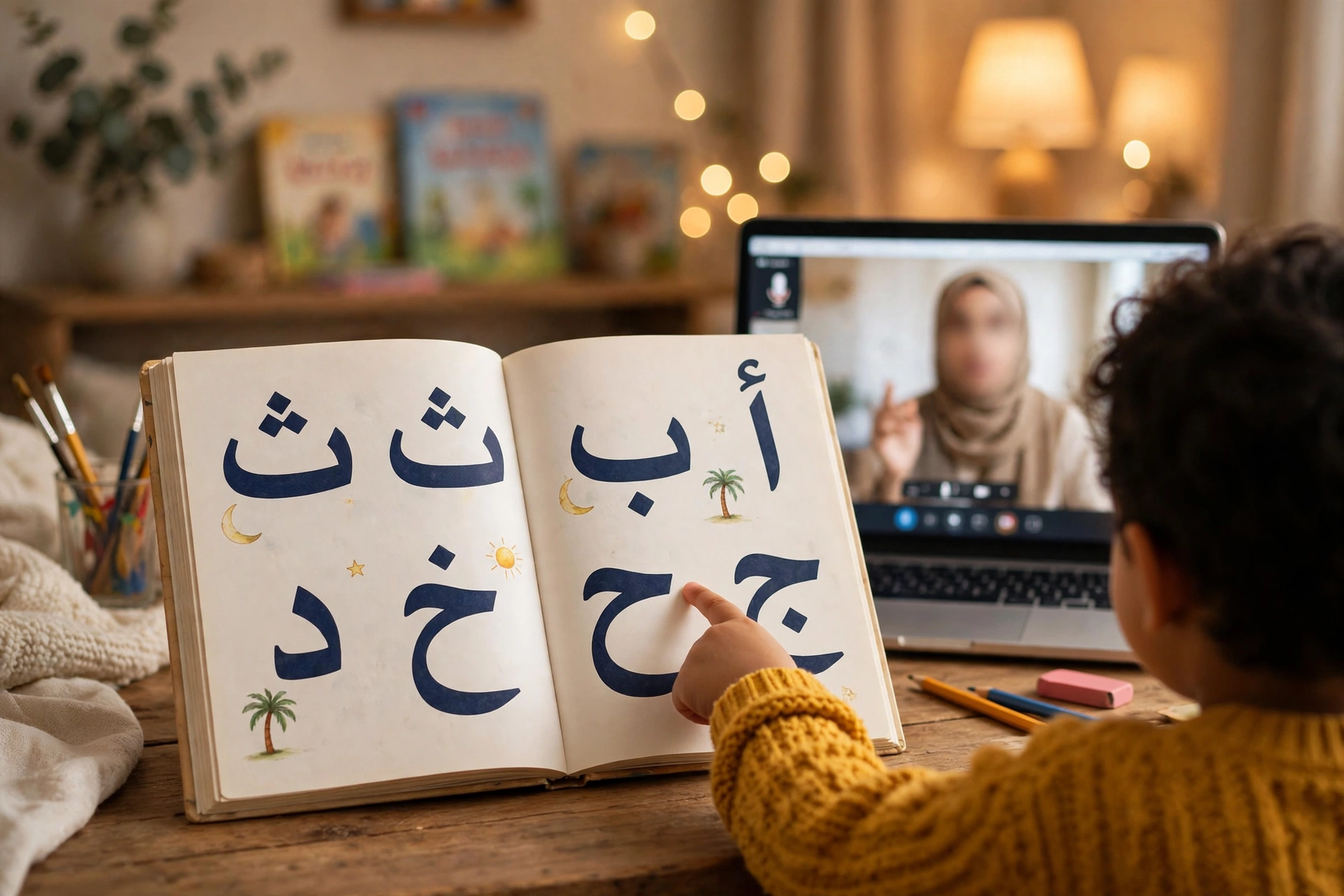
Starting is simple. Book a free trial class and say you are a complete beginner. The teacher will meet you in a live one-to-one video lesson, check what you already know, and show you what the first Qaida lesson looks like.
The trial is a real lesson, not a sales call. You will learn a few letters, hear how the teaching works, and get an honest recommendation about where to start and how many lessons a week would suit you. There is no payment, no obligation, and no expectation that you decide on the spot.
All you need is a device with a camera and microphone and a quiet spot. If you have a copy of Noorani Qaida at home, keep it nearby; if not, the teacher works from the screen.
Checklist — starting Noorani Qaida
- ✔ Book a free trial class and say you are a complete beginner.
- ✔ Learn the letters first — sound before shape, one lesson at a time.
- ✔ Do not skip lessons — each one assumes the one before it.
- ✔ Practise a few minutes every day between lessons, even just repeating the letters.
- ✔ Let your teacher check each lesson before you move on.
- ✔ After the Qaida, move on to reading the Quran itself (Nazra) with a teacher.
Frequently Asked Questions
What is Noorani Qaida in simple words?
Noorani Qaida is a beginner’s primer that teaches you how to read the Quran. It starts with the Arabic letters and builds up step by step — joining, vowels, and the first rules of recitation — over 17 short lessons. It is a teaching book, not a copy of the Quran.
How many lessons are in Noorani Qaida?
There are 17 lessons, in a fixed order. They run from single letters through joined letters, vowels, long vowels, and the marks that change how letters sound, ending with the first Tajweed rules. Each lesson assumes the one before it.
At what age should a child start Qaida?
Most children start from around age 4, once they can sit for a short session and follow instructions. Readiness matters more than the birthday — a child who can sit still for 15 minutes and follow a simple instruction is ready to begin.
Do adults need Noorani Qaida?
Yes, if they cannot yet read the Quran. Adults start the Qaida from zero in the same way children do, and usually move faster because they understand the logic and can practise on their own. Most adults finish it in 2–3 months with regular lessons.
How long does it take to finish?
Most children finish Noorani Qaida in 3–6 months with regular lessons, and most adults in 2–3 months — these are approximate ranges. The biggest factor is short daily practice between lessons. Rushing through it does not help; correct letters matter more than speed.
Is Noorani Qaida the same as learning Arabic?
No. Noorani Qaida teaches you to read Quranic Arabic — the letters, sounds and rules of recitation. Learning to speak Arabic is a different, much larger task. Many people who read the Quran fluently do not speak Arabic. Understanding the meaning comes later, through translation, after you can read.
Start Your Free Trial Today
Book a free trial class and start Noorani Qaida from the very first letter — a real one-to-one lesson with a teacher, no payment, no obligation. Book a free trial class →
Related reading
- Noorani Qaida course — where most beginners start
- Learn Quran Online — how online Quran classes work, for kids and adults
- How to Learn the Quran with a Busy Schedule



0 Comments