
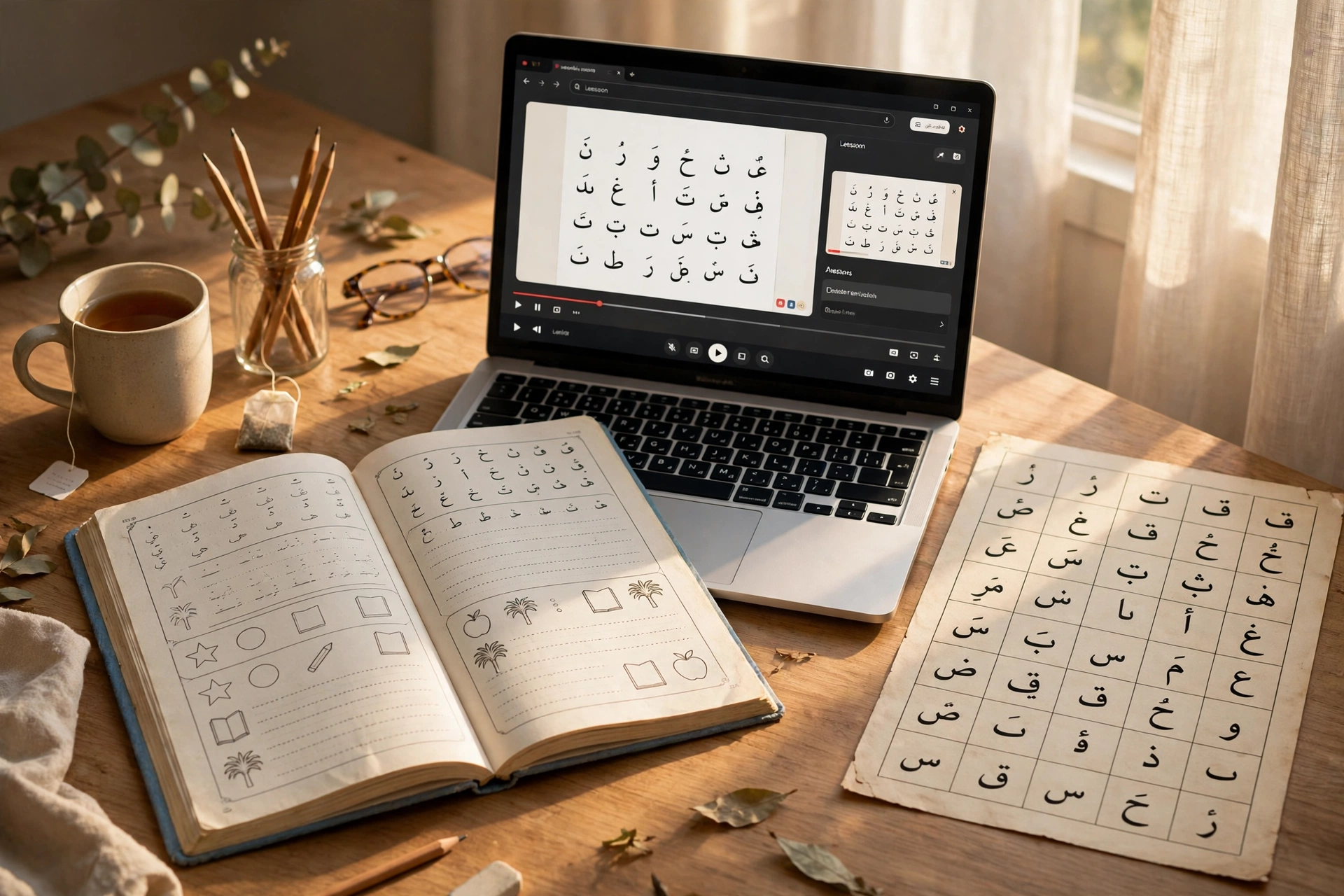

Arabic has 29 letters, each with its own sound and up to four written shapes — learning them by sound first, then shape, is the fastest way to start reading the Quran. The letters are the foundation of everything: every word, every verse, every page of the Quran is built from these 29.
Key takeaways
- Arabic has 29 letters — each with its own sound and up to four written shapes.
- Learn by sound first, then shape: hear the letter, say it, then learn how it is written.
- Some letters look alike and differ only by dots; others have no English equivalent at all.
- A teacher checks each letter before you move on — a correct letter now saves weeks later.
The 29 letters, and why sound comes before shape
There are 29 letters in the Arabic alphabet. Each one has its own sound, and each one has up to four written shapes — one for when it stands alone, one for the start of a word, one for the middle, and one for the end. That is the whole system, and it is simpler than it first looks: the shapes follow rules, and once you know the rules, the shapes make sense.
The fastest way to learn the letters is by sound first, then shape. Hear the letter, say it, and only then learn how it is written. The reason is simple: reading is a sound skill. When you read a word, you need to know what each letter sounds like — the shape is only the way the sound is written down. A student who knows the sounds can start reading joined words almost immediately; a student who only knows the shapes is still guessing at the sounds.
Your teacher will teach the letters this way: one letter at a time, sound first, with lots of repetition. You say the letter after the teacher, then you say it alone, then you move on to the next one — revising the ones you already know before adding new ones. A few letters per lesson is the right pace. Rushing through all 29 in a week does not work, because the sounds have not settled.
Nouman Ali Khan teaches Arabic the same way: the idea first, the term second. He shows what a letter or a grammatical point does in a real verse before naming it, and he explains everything in plain English. That is how the letters should be learned too — sound first, then shape, then the name. The name matters less than the sound; the sound is what you read.
The letters most beginners mix up
Some letters look almost identical and differ only by dots — one dot, two dots, three dots, or no dot at all. These are the letters beginners mix up most, and they are the reason teachers slow down on the early lessons. The fix is patient, side-by-side drilling: the teacher shows the two letters together, the child or adult says each one, and they repeat until the difference is clear. It feels slow, and it is — but a letter learned correctly now is a letter that never needs fixing later.
Another group beginners mix up are the letters that sound similar to an English ear but are different letters in Arabic. English has one “s” sound, one “t” sound, one “h” sound; Arabic has several of each, made in different places. To an English speaker, two different Arabic letters can sound like the same letter — until the ear is trained. A teacher trains the ear by saying the two sounds side by side and asking the student to hear the difference, then to make it. That takes time, and it is time well spent.
The third group is the letters with no English equivalent at all — the throat letters and the emphatic letters. These do not sound like any English letter, so there is nothing to compare them to. They must be learned as new sounds, by hearing them and copying them, with a teacher listening and correcting. Most learners find these the hardest at first, and the most satisfying once they click.

Letters that change shape at the start, middle and end of words
Most Arabic letters change shape depending on where they sit in a word. A letter at the start of a word looks different from the same letter in the middle, and different again at the end. A letter standing alone has a fourth shape. This is the part of the alphabet that looks complicated — but it follows rules, and the rules are simple once you see them.
The key rule is joining. Most letters join to the letter after them, and the shape changes to show the join. A small group of letters — six of them — never join to the next letter, and that is the first joining rule to learn. Once you know which letters join and which do not, the shapes start to make sense: the shape is simply the letter, adjusted to show whether it is joined on one side, both sides, or neither.
Your teacher will not teach all four shapes of every letter at once. You learn the shapes as you meet them, in real words, a few at a time. The first shape you learn is the standalone form; the joined forms come as you start reading words. By the time you finish the Qaida, you will have met every letter in every position, and the shapes will feel natural.
Letters with no English equivalent
Arabic has letters English does not have, and these are the ones that take the most practice.
The throat letters are made in the throat, and English has almost nothing like them. There are six of them, made at the bottom, middle and top of the throat. English speakers mix them up because English has no equivalents for most of them — to an untrained ear, two different throat letters can sound like the same sound. Learning them means learning to hear the difference first, then to make it, with a teacher listening.
The emphatic letters are the other group with no English equivalent. These are pronounced with a full, deep sound — the mouth is fuller, the sound is heavier — and they change the sound of the vowels around them. English has no equivalent, so learners often read them as their lighter cousins, which changes the word. A teacher corrects this by ear, one letter at a time.
Neither group is impossible. Both simply need more sessions than the letters that match English sounds, and a teacher who listens carefully. Most learners are surprised by how quickly the new sounds start to feel natural once they have practised them for a week or two.
A simple 2-week plan to learn all 29
Here is a realistic plan for learning all 29 letters in about two weeks, with regular lessons and a few minutes of daily practice. It is a guide, not a timetable — your teacher will adjust it to your pace.
Days 1–3: the first group of letters — the ones with sounds close to English. Learn a few per lesson, by sound first, then shape. Revise the ones you already know before adding new ones.
Days 4–7: the remaining letters, including the ones that look alike. This is the week to slow down: drill the similar-looking letters side by side until the difference is clear. Do not rush past a letter you are unsure of.
Days 8–10: the throat letters and the emphatic letters. These need extra sessions, because the sounds are new. Listen, copy, be corrected, and try again. A few minutes of extra practice on these sounds each day makes a real difference.
Days 11–14: joining and shapes. Start reading joined words, learning the shapes as you meet them. By the end of the second week, you should be able to recognise every letter and read simple joined words — and you will be ready for the vowel marks, which come next in the Qaida.
If a stage takes longer than the plan suggests, that is fine. A letter learned properly in three weeks is worth more than a letter rushed in three days and forgotten in a week.
How a teacher checks each letter before moving on
A teacher checks a letter by listening, not by asking you to name it. The test is simple: the teacher points to a letter, you say its sound; the teacher shows it in a word, you read the word; the teacher shows a similar-looking letter, you tell them apart. When you can do all three without guessing, the letter is learned — and only then does the teacher move on.
This checking matters because a letter learned wrong is expensive. It is not just one wrong sound — it is every word that letter appears in, read wrong, until someone corrects it. And correcting a habit takes longer than learning it right the first time. A teacher who holds you on a letter until it is correct is not being slow; they are saving you weeks of repair later.
That is also why self-study does not work well for the letters. You cannot hear your own mistakes — your ear hears what you expect to hear, not what you actually said. A teacher’s ear is the check that makes the difference, and it is the reason the letters are best learned in a lesson, not alone.
Checklist — learning the 29 letters
- ✔ Learn by sound first, then shape — hear the letter, say it, then learn how it is written.
- ✔ Learn a few letters per lesson, and revise the ones you already know before adding new ones.
- ✔ Drill similar-looking letters side by side until the difference is clear.
- ✔ Spend extra sessions on the throat letters and the emphatic letters — they have no English equivalent.
- ✔ Learn the shapes as you meet them in real words — do not try to memorise all four shapes at once.
- ✔ Let your teacher check each letter by listening before you move on.
Frequently Asked Questions
How many letters are in the Arabic alphabet?
There are 29 letters in the Arabic alphabet. Each one has its own sound and up to four written shapes — standalone, start of a word, middle, and end. Every word in the Quran is built from these 29 letters.
Which Arabic letters are hardest for English speakers?
The throat letters and the emphatic letters, because English has no equivalents for them. The throat letters are made in the throat, and the emphatic letters are pronounced with a full, deep sound. Both groups need extra sessions with a teacher listening and correcting. Letters that look alike and differ only by dots are also commonly mixed up at first.
Do Arabic letters change shape?
Yes. Most letters change shape depending on whether they sit at the start, middle or end of a word, or stand alone — so most letters have up to four shapes. A small group of six letters never join to the next letter. You learn the shapes as you meet them in real words, a few at a time.
How long does it take to learn the letters?
About two weeks with regular lessons and a few minutes of daily practice is realistic for most learners — though the throat letters and the emphatic letters may need extra sessions. These are approximate ranges. Rushing through the letters does not help; correct sounds matter more than speed.
What is the difference between similar-looking letters?
Some letters look almost identical and differ only by dots — one dot, two dots, three dots, or no dot at all. They are different letters with different sounds, and mixing them up changes the word. Teachers drill these side by side until the difference is clear.
Should I learn letter names or sounds first?
Sounds first. When you read, you need to know what each letter sounds like — the name is only a label for the sound. Learn the sound, then the shape, and the name will follow naturally. A teacher will teach the letters this way: sound first, with lots of repetition.
Start Your Free Trial Today
Book a free trial class and start learning the letters with a teacher — a real one-to-one lesson, no payment, no obligation.
Related reading
- Noorani Qaida course — where most beginners start
- Learn Quran Online — how online Quran classes work, for kids and adults
- How to Learn the Quran with a Busy Schedule



0 Comments