


Most children are ready for structured Quran lessons between ages 4 and 7, once they can sit for a short session and follow instructions. Readiness matters more than the birthday — a focused 5-year-old will progress faster than a restless 7-year-old who is not ready yet.
Key takeaways
- ✔ Most children are ready for structured Quran lessons between ages 4 and 7.
- ✔ Readiness — sitting still, listening, and following instructions — matters more than age.
- ✔ Start with listening and letters, then Noorani Qaida, then Tajweed — in that order.
- ✔ Starting late is fine. Older children and teenagers catch up quickly with regular lessons.
The 4–7 Window: Why These Ages Work Best
Between the ages of 4 and 7, most children hit a sweet spot for learning to read the Quran. They can sit still for a short lesson, they enjoy repetition, and their ears are very good at picking up new sounds. The Arabic letters and their sounds are new to them, but at this age children absorb new sounds easily and without the self-consciousness that older learners sometimes feel.
This is also the age when a short daily routine is easiest to build. A 15- to 20-minute lesson, two or three times a week, fits naturally into a young child’s day. The lessons are short enough to hold attention and regular enough to build real progress. Parents often find that a child who starts at 5 or 6 settles into the routine faster than a child who starts at 3, simply because the older child can focus a little longer.
That said, 4 to 7 is a guide, not a rule. Some children are ready at 4; others are not ready until 6 or 7. The window is wide because children develop at different speeds. What matters is whether your child shows the signs of readiness below — not whether they have had a particular birthday.
What Readiness Looks Like at Each Age
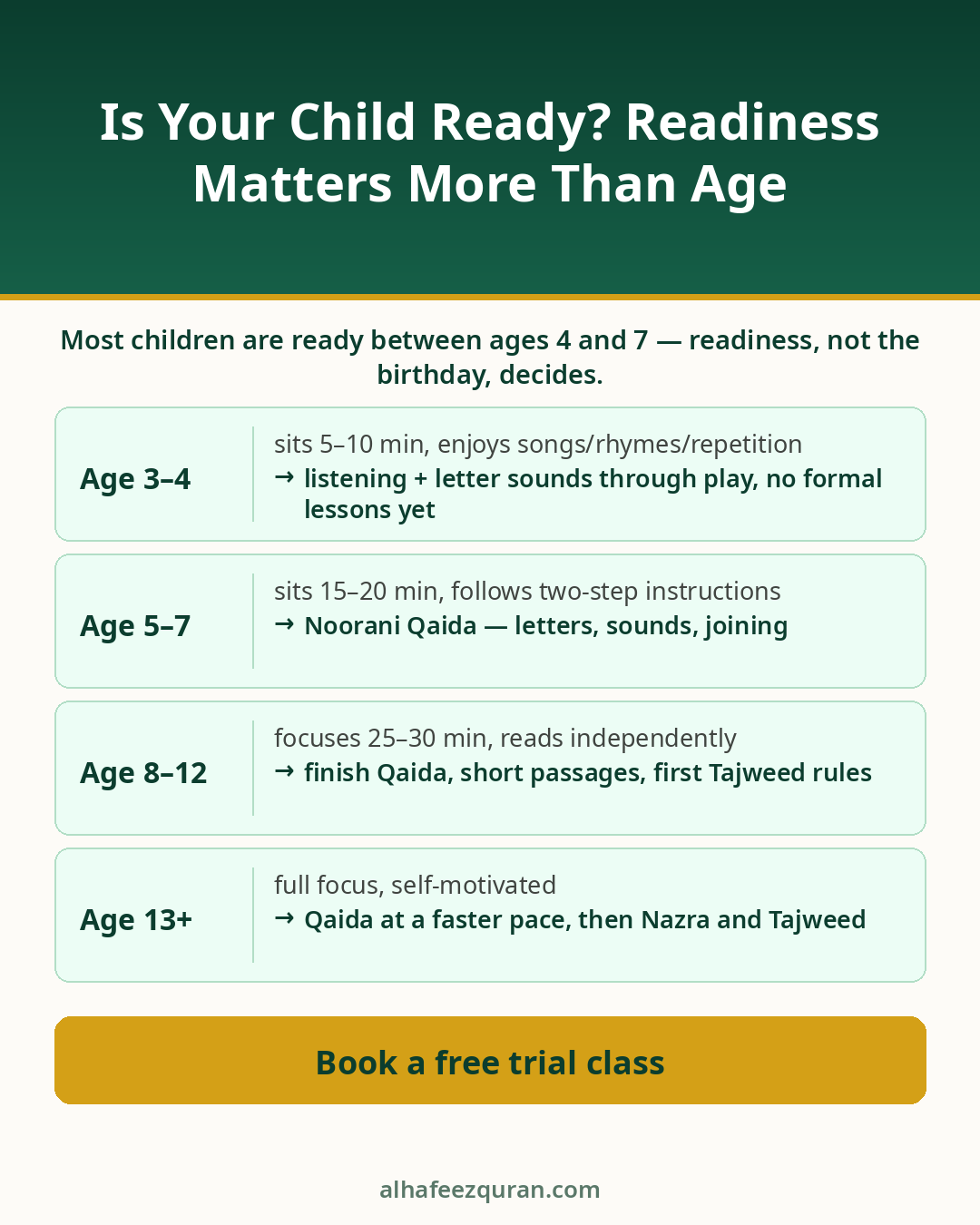
Readiness is not one thing. It changes as a child grows. Here is what to look for at each stage, and what to teach first.
| Age | Readiness signs | Teach first |
|---|---|---|
| 3–4 | Can sit for 5–10 minutes; enjoys songs, rhymes and repetition; recognises a few letters. | Listening, letter sounds through play, short rhymes — no formal lessons yet. |
| 5–7 | Can sit for 15–20 minutes; follows two-step instructions; can repeat sounds back clearly. | Noorani Qaida — letters, their sounds, and joining them together. |
| 8–12 | Can focus for 25–30 minutes; reads independently; self-corrects with gentle guidance. | Finish Qaida, then read short passages, then the first Tajweed rules. |
| 13+ | Full focus; self-motivated; can practise alone between lessons. | Qaida at a faster adult pace, then Nazra (reading the Quran) and Tajweed. |
At 3 or 4, the goal is not a lesson — it is exposure. Let your child hear the Quran, hear the letters, and enjoy the sounds. Short, playful sessions of 5 to 10 minutes are enough. If your child enjoys it, that enjoyment is the foundation everything else is built on.
At 5 to 7, formal lessons begin. This is the age for Noorani Qaida, the beginner’s primer that teaches the Arabic letters, their sounds, and how they join together. Lessons are still short — 15 to 20 minutes — but they are now structured, with a teacher guiding each step.
At 8 to 12, children can handle longer lessons and more independent practice. They finish Qaida faster and move on to reading from the Quran itself, then to the first Tajweed rules that make their recitation correct.
At 13 and above, teenagers learn at close to an adult pace. They can focus, they can practise alone, and they can move through Qaida quickly. A teenager starting from zero is not behind — they are simply starting at a different speed.
What to Teach First at Each Age
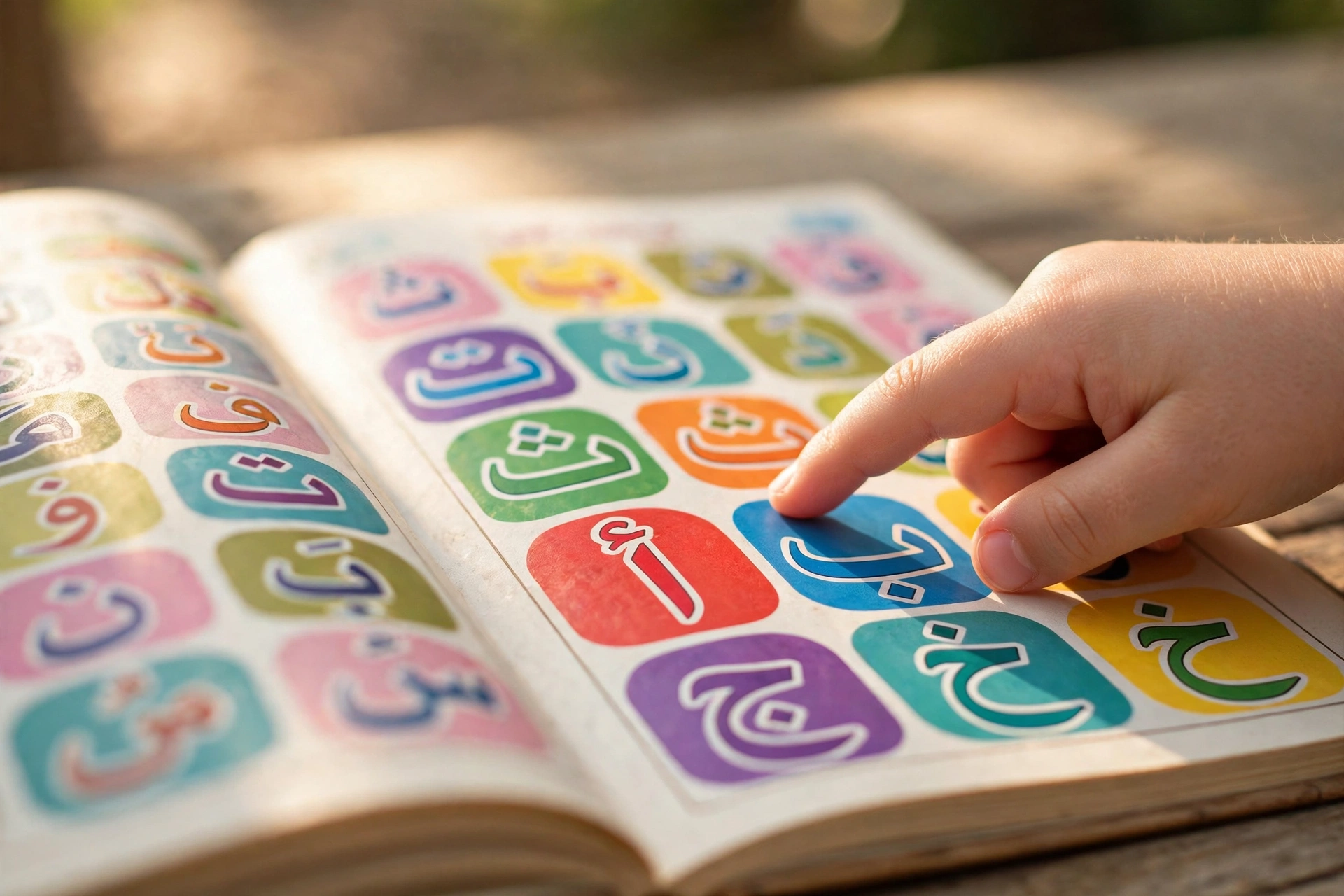
The order is the same at every age: listening first, then letters, then joining, then reading, then Tajweed. What changes is the pace, not the sequence.
Listening comes first. Before a child reads a single letter, they should hear the sounds of the Quran. Parents can play recitation at home, read aloud with their child, and let the sounds become familiar. This is especially valuable for children under 5, where listening is the whole lesson.
Next comes Noorani Qaida. This is the step where a child learns the Arabic letters, their sounds, and how letters join to form words. Qaida is the foundation — a child who rushes through it will struggle later, while a child who learns it properly will read fluently. Most children take about 3 to 6 months to finish Qaida with regular lessons, and adults usually take 2 to 3 months. These are approximate ranges; the exact time depends on lesson frequency and daily practice.
After Qaida comes Nazra — reading the Quran itself, starting with short passages. And after fluent reading comes Tajweed, the rules of correct pronunciation. Tajweed is not rushed. It is layered on gradually, one rule at a time, once the child can already read.
The mistake to avoid is skipping a step. A child who jumps from letters straight to the Quran without learning to join them will guess at words instead of reading them. A child who starts Tajweed before they can read fluently will be overwhelmed. Each step prepares the next one.
Signs Your Child Is Not Ready Yet — and What to Do Instead
Not every child is ready at 4 or 5, and that is normal. Here are the signs that your child needs more time:
- They cannot sit still for even 5 to 10 minutes without becoming upset or restless.
- They cry or resist when a lesson starts, every time — not just on a bad day.
- They show no interest in letters, books, or listening, even in a playful setting.
- They cannot yet follow a simple instruction, such as “point to the letter” or “repeat after me.”
If you see these signs, the answer is not to push harder. It is to wait and to keep the Quran present in a gentle way. Play recitation in the background. Read a short passage aloud together at bedtime. Let your child hold a Quran and turn the pages. Point at letters and name them as a game, with no pressure to remember.
Then try again in a few months. Readiness often arrives suddenly — a child who was not ready at 4 and a half may be eager at 5. Waiting a few months costs nothing. Starting too early and creating a negative association with lessons costs a great deal, because it can take much longer to undo.
If you are unsure, a free trial class is a good test. A teacher can tell in one short session whether your child is ready for structured lessons, or whether a few more months of listening and play would serve them better.
Why Starting Late Is Fine
Some parents worry that starting at 8, 10, or 12 means their child is behind. It does not. Older children learn faster. A 10-year-old who starts Qaida will often finish it in half the time a 5-year-old takes, because they can focus longer, understand instructions the first time, and practise on their own.
Teenagers catch up faster still. A teenager starting from zero can often reach fluent reading within a year of regular lessons, because they bring adult focus to the task. And adults who never learned as children also learn well — usually faster than children at the understanding stage, because they can practise independently between lessons.
The age you start matters far less than the consistency you keep once you start. A child who starts at 6 and has two lessons a week, every week, will be reading confidently within a year. A child who starts at 4 but has irregular lessons and no practice will still be struggling at 7. Regular lessons and short daily practice beat an early start every time.
So if your child is 9, 12, or 15 and has not started yet, do not worry about the lost years. Start now, keep the lessons regular, and the progress will come.
How a Free Trial Class Helps You Judge Readiness
The simplest way to answer the age question for your own child is to try a real lesson. In a free trial class at Al Hafeez Online Quran Academy, the teacher spends the first part of the lesson gently assessing where your child is: can they sit and listen, can they repeat sounds, do they know any letters yet?
After the trial, the teacher tells you honestly what they found — whether your child is ready for structured Qaida lessons, or whether a few more months of listening and play would be better. There is no pressure to enrol. The trial exists so you can make an informed decision about your child’s readiness, with a teacher’s judgement rather than guesswork.
A trial also lets your child experience a lesson before you commit. Some children who seem restless at home settle beautifully with a teacher. Others need more time. Either answer is useful, and either way you will know more after the trial than before it.
Frequently Asked Questions
What age should my child start Noorani Qaida?
Most children start Noorani Qaida between ages 4 and 7, once they can sit for a 15-minute lesson and follow simple instructions. If your child is not ready yet, a few months of listening and play at home is the right preparation, and you can start Qaida when they are ready.
Is 3 too young for Quran classes?
Three is too young for structured lessons, but it is a good age for gentle exposure. Play recitation, read aloud together, and let your child hear the letters as sounds and songs. Formal Qaida lessons usually start at 4 or 5, when a child can sit and focus for a short session.
Can a 12-year-old start from zero?
Yes. A 12-year-old starting from zero is in a strong position — they can focus for a full lesson, understand instructions quickly, and practise on their own. Older children usually move through Qaida faster than younger ones, and they catch up to their peers within months of regular lessons.
How long should a 5-year-old’s class be?
About 15 to 20 minutes. That is long enough to learn something real and short enough to hold a young child’s attention. Longer lessons at this age usually end in restlessness, not more learning. As the child grows, lesson length grows with them — up to 30 minutes for older children.
What if my child can’t sit still for a lesson?
First, check the lesson length — a 5-year-old cannot sit for 30 minutes, and that is normal. Shorten the session, add movement between parts, and keep it playful. If your child still cannot settle even for a short session, they may simply need a few more months before structured lessons. Keep listening and playing with letters at home, and try a trial class again later.
Is it too late to start as a teenager?
No. Teenagers learn quickly because they can focus, follow instructions, and practise independently. A teenager who starts from zero and has two or three lessons a week can reach fluent reading within about a year. Starting late is never a disadvantage when the lessons are regular.
Start Your Free Trial Today
Not sure if your child is ready? Book a free trial class and let a teacher assess them in a real lesson — no payment, no obligation. Book your free trial class



0 Comments