



Most children learn to read the Quran in about 6 to 12 months of regular lessons, and most adults in 3 to 6 months. The exact time depends on age, lesson frequency, and daily practice — but with two or three lessons a week and a few minutes of practice a day, steady progress is the normal result.
Key takeaways
- ✔ Most children learn to read the Quran in about 6–12 months; most adults in 3–6 months.
- ✔ Learning happens in three stages: letters, joining, then fluent reading.
- ✔ Short daily practice matters more than long, irregular sessions.
- ✔ Irregular lessons and skipping the Qaida are the two biggest causes of slow progress.
The Short Answer: A Timeline by Age and Lessons
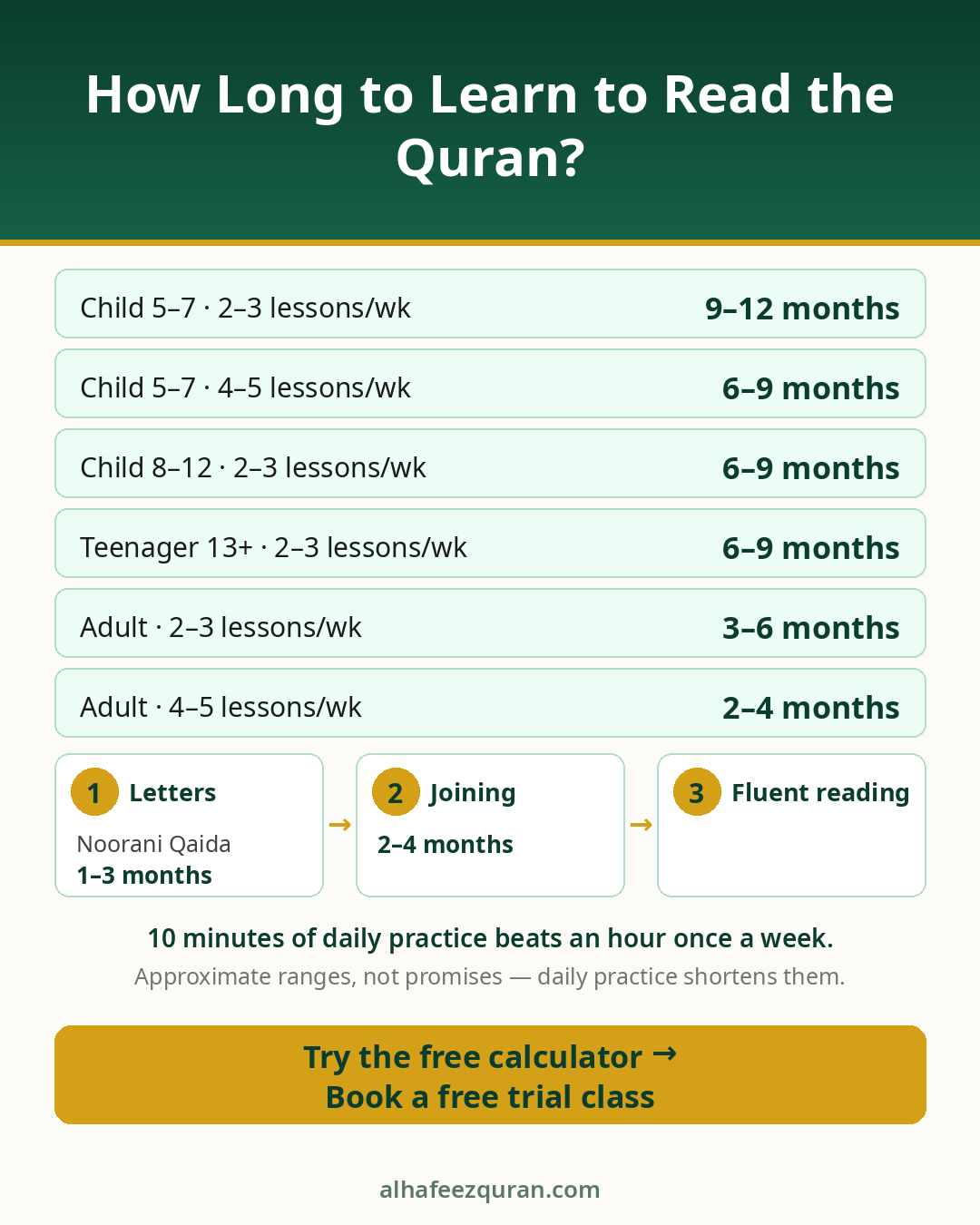
There is no single answer, because the time depends on the learner. But the ranges below are a realistic guide, based on regular lessons and short daily practice. All times are approximate — your child’s exact time will depend on their age, focus, and how often they practise.
| Learner | Lessons per week | Time to read the Quran |
|---|---|---|
| Child, age 5–7 | 2–3 lessons per week | 9–12 months |
| Child, age 5–7 | 4–5 lessons per week | 6–9 months |
| Child, age 8–12 | 2–3 lessons per week | 6–9 months |
| Teenager, age 13+ | 2–3 lessons per week | 6–9 months |
| Adult | 2–3 lessons per week | 3–6 months |
| Adult | 4–5 lessons per week | 2–4 months |
Want an estimate for your child or yourself? Try the free calculator →
Children take longer than adults, and that is normal. A young child is learning to focus, to sit still, and to recognise letters all at the same time. An adult already has those skills and only needs to learn the letters and sounds. The child’s longer timeline is not a problem — it is the natural pace of learning at that age.
Lesson frequency matters a great deal. A child with two lessons a week will take roughly twice as long as a child with four lessons a week, because the gap between lessons is where forgetting happens. Daily practice closes that gap. Even 10 minutes a day of revision keeps the previous lesson fresh, so each new lesson builds on solid ground instead of starting over.
It is worth saying plainly: these are approximate ranges, not promises. A child who practises daily will beat the range. A child who has lessons once a week and never practises will take much longer. The timeline is a guide for planning, not a deadline.
The Three Stages: Letters, Joining, Fluent Reading
Learning to read the Quran happens in three clear stages. Each one depends on the one before it, and skipping a stage is the most common reason learners get stuck.
Stage 1 — Letters. The learner meets the Arabic letters one by one: their names, their sounds, and their shapes. This is the Noorani Qaida stage. It feels slow at first, because every letter is new. But it is the foundation. A learner who knows the letters properly will find every later stage easier. This stage usually takes the first 1 to 3 months, depending on age and lesson frequency.
Stage 2 — Joining. Letters in Arabic join together to form words, and most letters change shape depending on where they sit in a word. In this stage the learner practises joining letters, reading short words, and adding the vowel marks that tell you how each letter sounds. This is where reading starts to feel real — the learner is no longer naming letters, they are reading words. This stage usually takes 2 to 4 months.
Stage 3 — Fluent reading. The learner now reads whole words and short sentences without stopping to work out each letter. They move from the Qaida to reading from the Quran itself, starting with short passages. Fluency builds gradually: first slowly and carefully, then with more confidence and speed. This stage is ongoing — fluency deepens over months of reading — but a learner can usually read short passages independently within the timelines in the table above.
After fluent reading comes Tajweed, the rules of correct pronunciation. Tajweed is a separate stage, learned gradually once the learner can already read. It is not part of the “learning to read” timeline, but it is the natural next step.
What Slows Learners Down
Three things slow learners down more than anything else. All three are avoidable.
Irregular lessons. A lesson once a week, then a missed week, then two lessons, then a gap — this pattern is the single biggest cause of slow progress. Each gap lets the previous lesson fade, so the next lesson spends half its time re-teaching what was already covered. Regular lessons, even just two a week, beat irregular lessons every time.
No revision between lessons. The lesson is where new material is taught. Revision is where it is learned. A learner who never looks at the material between lessons will forget most of it by the next lesson. Just 10 minutes a day — reading the last page again, or repeating the letters — makes a dramatic difference. Without it, progress is slow and frustrating.
Skipping the Qaida. Some learners, especially older ones, want to jump straight to reading the Quran. They skip the Qaida because it feels too basic. This almost always backfires. The Qaida teaches joining, vowels, and the rules that make reading possible. A learner who skips it will guess at words instead of reading them, and the guessing becomes a habit that is hard to break. Finishing the Qaida properly is the fastest route to reading, not the slowest.
What Speeds It Up
The good news is that the things that speed learning up are simple and entirely in your control.
Short daily practice. Ten minutes a day beats an hour once a week. Daily practice keeps the material fresh, builds the habit, and lets the learner arrive at each lesson ready to move forward instead of catching up. For a child, 10 minutes of reading with a parent is enough. For an adult, 10 to 15 minutes of reading aloud is enough.
One-to-one correction. In a one-to-one lesson, every mistake is heard and corrected immediately. The teacher hears the wrong sound, stops the learner, and fixes it on the spot. That immediate correction is what builds correct pronunciation. In a group, mistakes can go unnoticed for weeks. One-to-one lessons are the fastest way to learn to read correctly, because the teacher’s full attention is on one learner.
Reading aloud. Reading silently does not build reading skill. Reading aloud — slowly, carefully, and with the teacher listening — is what builds fluency. The learner should read aloud in every lesson and in every practice session. Hearing their own voice, and hearing the teacher correct it, is how the sounds become natural.
A fixed schedule. Lessons at the same time, on the same days, every week. A fixed schedule removes the daily decision about whether to have a lesson, and it builds the routine that carries learning forward. Families who keep a fixed schedule progress noticeably faster than families who schedule week by week.
How to Know Your Child Is Ready to Move from Qaida to the Mushaf
Parents often ask when their child is ready to leave the Qaida and start reading from the Quran itself. There are four clear signs.
First, your child can read any page of the Qaida without hesitation — not just the pages they have practised most, but any page the teacher opens to. Second, they join letters correctly without having to sound out each letter separately. Third, they read the vowel marks correctly most of the time, without guessing. And fourth, they can read a short unfamiliar passage slowly but accurately, with only the occasional correction.
When all four are true, the teacher will move the child to the Mushaf. The first passages will be short, and the teacher will still be listening closely. The move is a milestone, not a finish line — the child is now reading the Quran, and their fluency will keep growing from there.
Do not rush this step. A child who moves to the Mushaf too early will struggle, lose confidence, and may need to go back to the Qaida. A child who moves when they are truly ready will find the transition smooth and encouraging. Trust the teacher’s judgement on the timing.
A Realistic First-Month Plan
If you are starting from zero, here is what the first month realistically looks like with two or three lessons a week.
Week 1: The teacher introduces the first few letters — their names, their sounds, and how to write them. The learner practises recognising them and saying them aloud. Daily practice is 5 to 10 minutes of looking at the letters and repeating them.
Week 2: More letters are added, and the learner begins to tell similar letters apart. The teacher checks each letter by asking the learner to point to it and say its sound. Daily practice continues at 5 to 10 minutes.
Week 3: The learner starts joining two letters together and reading their first simple combinations. This is an exciting week — reading is beginning. Daily practice grows to 10 minutes.
Week 4: The learner can recognise all the letters introduced so far, join them into short words, and read them aloud. The teacher reviews the month’s letters and confirms the foundation is solid before moving on.
That is the realistic pace. It is not fast, and it is not slow — it is the pace at which real learning happens. A learner who follows this plan for a month has a solid foundation. A learner who follows it for six months is reading.
Frequently Asked Questions
How long does Noorani Qaida take?
Most children finish Noorani Qaida in 3 to 6 months with regular lessons, and most adults in 2 to 3 months. The biggest factor is short daily practice between lessons — a learner who practises 10 minutes a day will finish noticeably faster than one who only attends lessons.
Can I learn to read the Quran in 3 months?
For an adult with 3 to 4 lessons a week and daily practice, yes — reading fluently in about 3 months is realistic. For a young child, 3 months is usually enough to finish the letters and start joining, but fluent reading typically takes longer. Be wary of any promise that guarantees a fixed time — the real timeline depends on the learner.
How many classes a week do I need?
Two to three classes a week is the recommended minimum for steady progress. One class a week is possible, but progress will be slow because the gap between lessons is long. Four to five classes a week will speed things up, but only if the learner can keep up the pace without burning out.
Does my child need to know Arabic first?
No. Learning to read the Quran does not require speaking Arabic. Noorani Qaida teaches reading from zero — the letters, their sounds, and how they join — and the teacher explains everything in a language your child understands. Most students read their first words within weeks, with no prior Arabic at all.
What comes after learning to read?
After fluent reading comes Tajweed — the rules of correct pronunciation. Tajweed is layered on gradually, one rule at a time, once the learner can already read. After Tajweed, many learners go on to memorisation (Hifz) or to learning the meaning of the Quran through translation. The path after reading depends on the learner’s goals.
How do I track progress?
Your teacher should tell you plainly what your child has covered and what comes next. At Al Hafeez Online Quran Academy, parents receive monthly progress reports showing which lessons have been completed and what the child is working on. You can also track it yourself: ask your child to read a page they have not seen before, and listen to how smoothly they read it.
Start Your Free Trial Today
See where you or your child stand with a real one-to-one lesson — the teacher will assess your level and show you the path forward. Book your free trial class →



0 Comments