

Online Quran Classes vs Mosque Classes: Which Is Better for Your Child?
Both work — mosque classes give community, one-to-one online classes give far more corrected recitation time per week. The right choice depends on what your child needs most. For most families, the honest answer is not one or the other, but a clear understanding of what each one actually delivers.
Key takeaways
- ✔ Both mosque and online classes can teach your child to read the Quran well.
- ✔ One-to-one online lessons give far more corrected reading time per week than a group class.
- ✔ Mosque classes give community, congregation, and a shared routine that online learning cannot replace.
- ✔ Many families use both — online for individual reading progress, mosque for community.
- ✔ The deciding questions are about your child: their age, their focus, and what they need most right now.
The Honest Trade-Off in One Paragraph
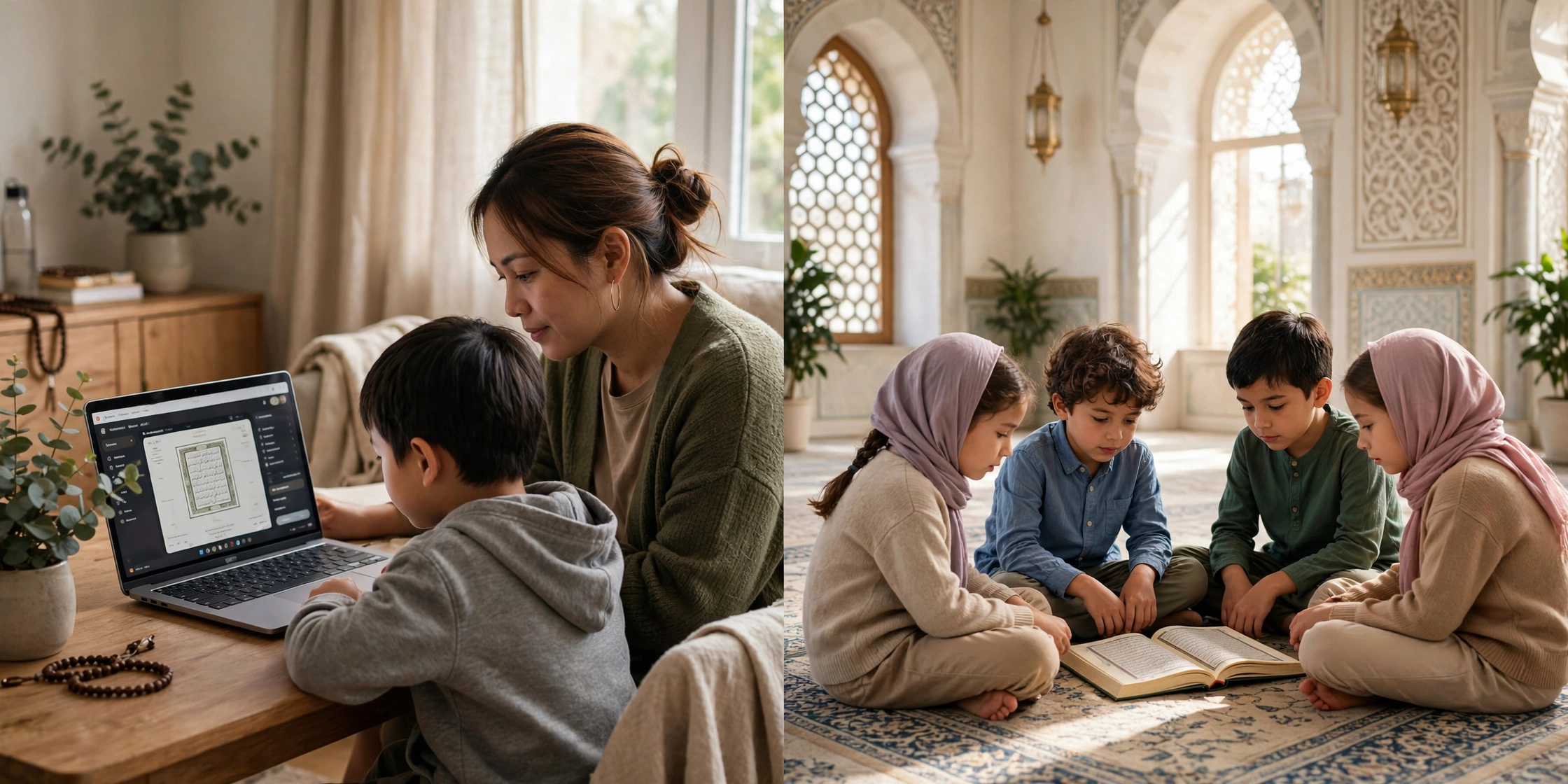
A mosque class puts your child in a room with other children, a teacher, and the shared atmosphere of the mosque. They hear others read, they feel part of something, and they build a habit tied to a place and a community. What they do not get is much individual attention — the teacher’s ear is shared among all the children in the room, so each child is corrected only briefly.
A one-to-one online class does the opposite. Your child gets the teacher’s full attention for the whole lesson. Every sound is heard. Every mistake is corrected immediately. But there is no room full of other children, no congregation, and no mosque atmosphere — the lesson happens at home, on a screen.
Neither is better in every way. They are better at different things. The question is which set of strengths matters more for your child right now.
Corrected Recitation Time per Week, Compared
The single biggest practical difference is how much time your child spends actually reading aloud while a teacher listens and corrects them. That is the time when learning happens. Everything else — listening to others, waiting your turn, group recitation — is useful, but it is not corrected reading time.
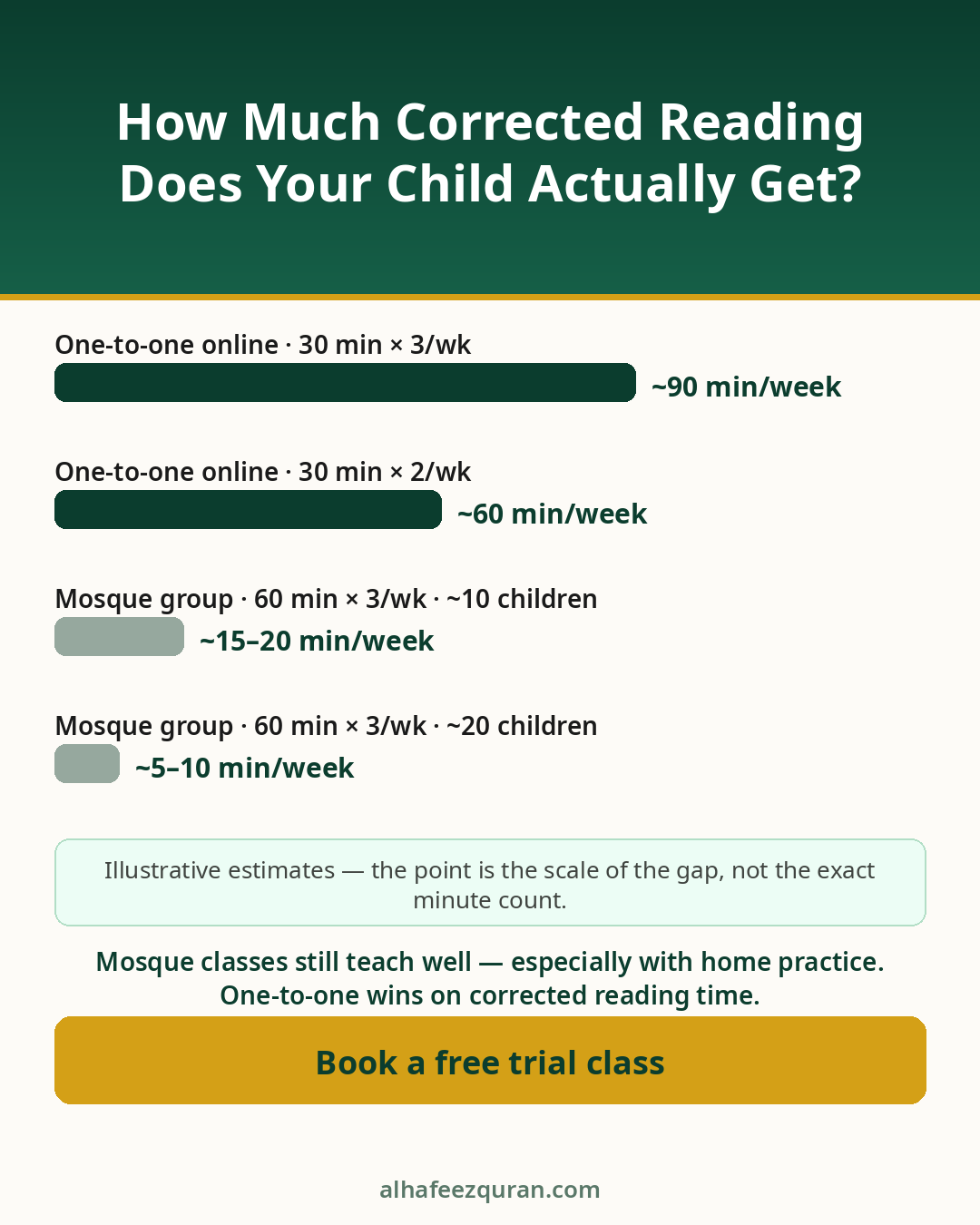
The table below is an illustrative comparison, not measured data. It shows what happens under stated, typical assumptions, so you can see the scale of the difference.
| Format | Schedule | What happens | Approximate corrected reading time per week |
|---|---|---|---|
| One-to-one online | 30 min, 3 times per week | The whole lesson is your child’s reading, heard and corrected by the teacher. | about 90 minutes |
| One-to-one online | 30 min, 2 times per week | The whole lesson is your child’s reading, heard and corrected by the teacher. | about 60 minutes |
| Mosque group class | 60 min, 3 times per week, about 10 children | Teacher’s attention is shared; each child reads aloud briefly while others listen or wait. | about 15–20 minutes |
| Mosque group class | 60 min, 3 times per week, about 20 children | Teacher’s attention is shared more thinly; each child’s turn is shorter. | about 5–10 minutes |
Note: Illustrative estimates. They assume a 60-minute group class in which the teacher hears each child read in turn, with the remaining time spent on group recitation, instruction, and waiting. Actual times vary with class size, the teacher’s method, and how the session is run. The point of the comparison is the scale of the gap, not the exact minute count.
The gap is large, and it is structural — it follows from the format, not from any teacher’s effort. In a one-to-one lesson, 100% of the time is your child’s. In a group of 10, roughly a tenth of the teacher’s attention is your child’s. A good mosque teacher works hard and the children do learn, but the arithmetic of shared attention cannot be beaten.
This does not mean mosque classes are ineffective. Children do learn in them, especially when they also practise at home. But if your priority is rapid, accurate progress in reading — particularly in the early stages, when every sound needs correction — then the amount of corrected reading time is the number that matters most, and one-to-one wins it by a wide margin.
Where Online Classes Win
Individual attention. The teacher hears every sound your child makes. Nothing is missed. A mispronounced letter is corrected the moment it happens, before it becomes a habit. This is the single greatest advantage of one-to-one teaching.
Scheduling. Online classes happen at a time you choose — after school, after work, on weekends, in any time zone. There is no travel, no fixed mosque timetable to fit around, and no missed class because of transport or weather. For busy families, this flexibility is often what makes regular lessons possible at all.
Teacher choice. Online, you can choose a teacher who fits your child: a male or female teacher, a teacher experienced with your child’s age group, a teacher who speaks your family’s language. In a mosque class, the teacher is whoever teaches that class. The choice matters, especially for young children and for sisters.
Parent can listen in. In an online lesson, a parent can sit nearby and hear exactly what is being taught, how the teacher speaks to the child, and how the child is progressing. That transparency is hard to get from a mosque class, where parents usually drop off and pick up without seeing the lesson.
Consistency. Because there is no travel and the time is flexible, online lessons are easier to keep regular. Regular lessons are the foundation of progress. A family that keeps three online lessons a week, every week, will outpace a family whose mosque attendance is irregular — however good the mosque class is.
Where the Mosque Genuinely Wins
Community. This is the mosque’s greatest strength, and it is real. A child who learns at the mosque is part of something — they see other children learning, they make friends who share the same goal, and they associate the Quran with a place and a people, not just a screen. That sense of belonging matters, and online learning cannot replicate it.
Congregation and atmosphere. Praying together, hearing the Quran recited in the mosque, being in a space dedicated to worship — these shape a child’s relationship with the Quran in a way that a lesson at home does not. The mosque is not just a classroom. It is a place of faith, and children absorb that.
Cost. Mosque classes are often run by the local community and are usually low-cost or free. For families where cost is a real constraint, this matters enormously. Online one-to-one classes have a fee — at Al Hafeez Online Quran Academy, monthly fees are $45 / $45 / $60 a month, depending on the plan. A mosque class will usually cost less than that. Cost is a legitimate factor in the decision, and it should be weighed honestly.
Routine and discipline. Going to the mosque at a set time, with other children, builds a routine that is tied to a place. Some children focus better in that setting than they do at home, where distractions are closer. The physical act of going somewhere to learn has a discipline to it that a lesson on a laptop does not always match.
Social learning. Children learn from each other. Hearing a slightly older child read well can inspire a younger one. Reading together, even briefly, builds confidence. The mosque gives children peers in their learning, and that peer effect is valuable.

The Hybrid Option Many Families Use
Many families do not choose one or the other. They use both, and each covers what the other lacks.
The most common hybrid is: one-to-one online lessons for reading progress, plus mosque attendance for community. The child has two or three online lessons a week, where the real reading progress happens — letters, joining, fluency, Tajweed — with a teacher’s full attention. And the child also attends the mosque, for prayers, for community, and for the shared atmosphere.
Another version is the reverse: mosque classes as the main learning, with an online tutor once a week to correct what the group class cannot. A child who reads in a group all week but is only corrected briefly can use a single weekly one-to-one session to fix the mistakes that have crept in.
Both hybrids work. The key insight is that the two settings do different jobs. Online is for individual progress. The mosque is for community and belonging. A family that uses both is not being indecisive — they are getting the best of each.
If cost is a concern, a hybrid can also be the economical choice: fewer online lessons (say, two a week instead of three) plus free mosque attendance, rather than either one alone at full intensity.
Five Questions to Decide for Your Family
There is no single right answer. Work through these five questions with your family, and the right choice will usually become clear.
- What does my child need most right now? If they are a beginner who needs every sound corrected, one-to-one online is the stronger choice. If they can already read and need motivation and community, the mosque may serve them better.
- How old is my child, and how well do they focus? Young children (4–7) often do better one-to-one, because a group setting is harder for them to focus in. Older children who are self-motivated can thrive in either setting.
- Can we get to the mosque regularly? If transport, distance, or schedule makes mosque attendance irregular, then online lessons — which happen at home, on time, every week — will deliver more consistent learning. A mosque class you attend twice a month teaches less than an online class you attend three times a week.
- What can we afford? Be honest about the budget. Mosque classes are usually low-cost or free. Online one-to-one has a monthly fee. If the fee is comfortable, one-to-one is the faster route. If it is a stretch, a hybrid — fewer online lessons plus mosque attendance — may be the best balance.
- What does my child want? Ask them. Some children love the mosque and their friends there. Others prefer the quiet focus of a one-to-one lesson. A child who enjoys their lessons will learn faster than a child who dreads them, whatever the format. Their preference is not the only factor, but it is a real one.
Answer these five, and you will know which setting — or which combination — fits your family.
Frequently Asked Questions
Are online Quran classes as effective as in-person?
Yes, for reading progress — and often more effective, because one-to-one online lessons give far more corrected reading time than a group class. What online cannot replace is the mosque’s community and atmosphere. Effectiveness depends on what you measure: for accurate reading, online one-to-one is very strong; for community belonging, in-person is stronger.
How much corrected reading does my child get in a mosque class?
It depends on the class size. In a group of around 10 children in a 60-minute session, each child might get roughly 5 minutes of individual reading time, with the rest spent listening, waiting, or reciting together. In a larger group, each child’s turn is shorter. This is an illustrative estimate — actual times vary — but the pattern holds: shared attention means less individual reading time.
Can my child do both?
Yes, and many families do. A common pattern is one-to-one online lessons for reading progress, plus mosque attendance for prayers and community. The two complement each other: online gives individual correction, the mosque gives belonging. There is no conflict between them.
Is online learning safe for children?
It can be, with the right setup. Choose an academy that lets parents listen in on lessons, that names its teachers, and that offers a real trial class so you can see how a lesson works before you commit. A parent should always be able to hear the lesson and know who is teaching their child. If an academy will not allow that, that is a reason to look elsewhere.
What does online cost compared with mosque classes?
Mosque classes are often run by the local community and are usually low-cost or free. Online one-to-one classes have a monthly fee. At Al Hafeez Online Quran Academy, monthly fees are $45 / $45 / $60 a month, depending on how many classes a week you take. The exact plan depends on your schedule — see the fee plan for the current rates.
Which is better for Tajweed?
One-to-one online lessons are generally better for Tajweed, because Tajweed is entirely about correcting individual pronunciation — and that requires the teacher to hear every sound your child makes. In a group class, Tajweed errors can go unheard for weeks. A child learning Tajweed benefits most from a teacher whose full attention is on their recitation.
Start Your Free Trial Today
Try a real one-to-one lesson and see the difference for yourself — free, with no obligation. Book your free trial class →



0 Comments