


Start with Noorani Qaida, take one-to-one live lessons 2–3 times a week, and practise 10–15 minutes a day. That is the whole path from zero to reading the Quran — no prior knowledge needed, no Arabic required, and no special equipment beyond a device and a quiet spot.
Key takeaways
- ✔ The path is four steps: Noorani Qaida, joining letters, Nazra (reading), then Tajweed.
- ✔ You need nothing before the first class except a device and a quiet spot.
- ✔ One-to-one live lessons suit beginners best — the teacher corrects you in the moment.
- ✔ With 2–3 lessons a week and 10–15 minutes of daily practice, most beginners read within months.
The 4-Step Path: From Zero to Reading the Quran
Learning the Quran online as a beginner follows a clear, proven sequence. There are four steps, and they always come in this order.
Step 1 — Noorani Qaida
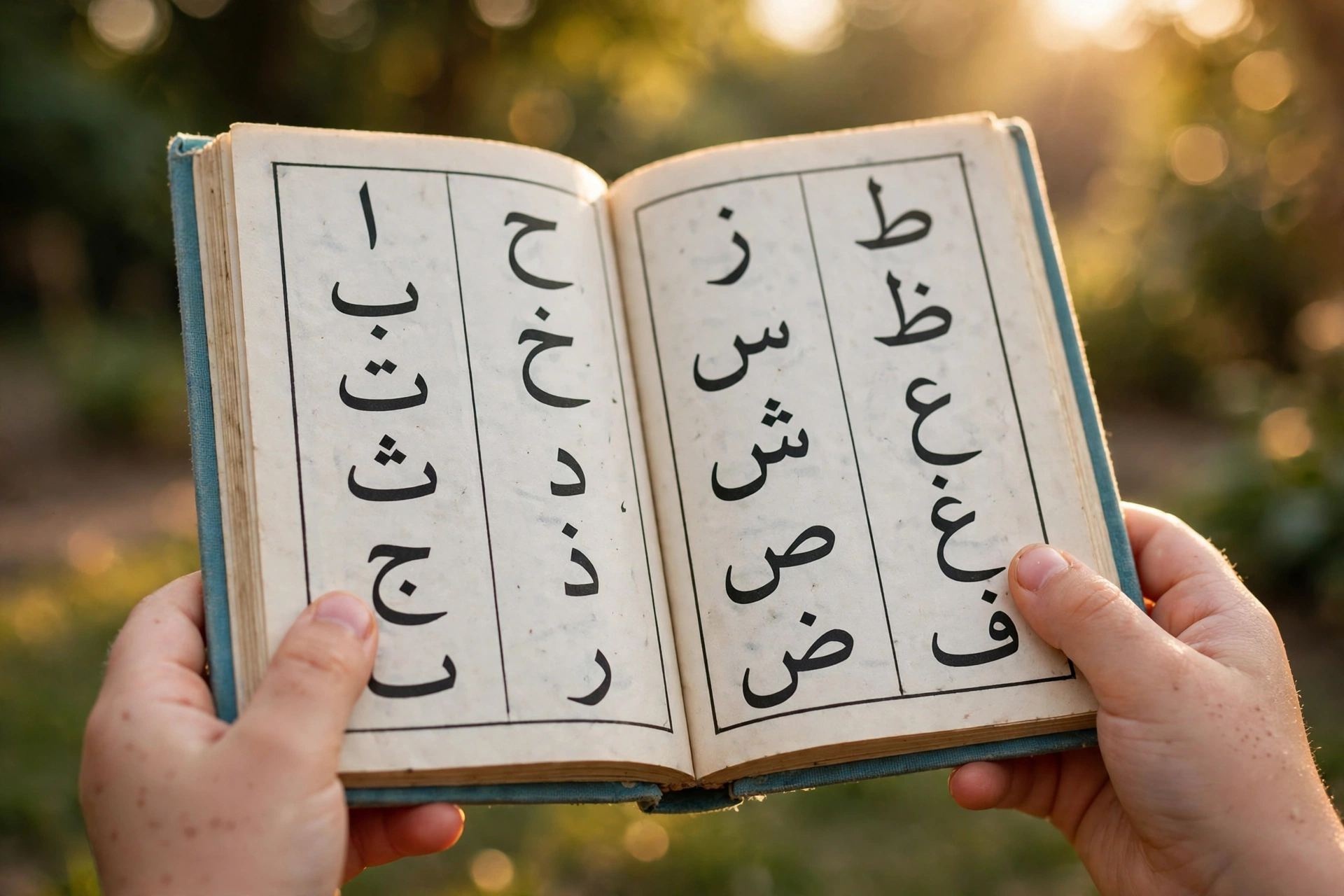
This is the beginner’s primer. It teaches the Arabic letters, their sounds, and how they join together. You start from zero — no reading ability assumed. Most children take about 3 to 6 months to finish Qaida with regular lessons; most adults take 2 to 3 months. These are approximate ranges. The Qaida is the foundation, and finishing it properly is what makes everything after it possible.
Step 2 — Joining letters into words
Once you know the letters, you learn how they connect. Arabic letters change shape depending on where they sit in a word, and learning to join them is the skill that turns letter knowledge into reading. This stage overlaps with the later Qaida lessons and takes a few weeks of guided practice.
Step 3 — Nazra (reading the Quran)
Now you read from the Quran itself, starting with short passages. At first you read slowly and carefully, with the teacher listening and correcting. Over weeks and months, your reading becomes smoother and more confident. This is the stage where you are genuinely reading the Quran.
Step 4 — Tajweed
Once you can read fluently, the rules of correct pronunciation are layered on gradually — one rule at a time. Tajweed makes your recitation correct and beautiful. It is not rushed, and it is not taught before you can read. It is the finishing stage, not the starting stage.
That is the whole path. Four steps, in order, with a teacher guiding each one. There are no shortcuts that work — but there is also nothing mysterious about it. A beginner who follows these steps with regular lessons will read the Quran.
What You Need Before the First Class
Almost nothing. This is one of the advantages of learning online.
You need a device — a laptop, tablet, or smartphone — with a camera and microphone, and a stable internet connection. You need a quiet spot where you can hear the teacher and the teacher can hear you. That is the complete equipment list.
You do not need to buy any books before the first class. The teacher will tell you what you need, and most academies — including Al Hafeez Online Quran Academy — provide the learning materials digitally. You do not need to know any Arabic. You do not need to know the alphabet. You do not need to have read any part of the Quran before.
What helps, but is not required, is a notebook and a pen. Some learners like to write down the letters as they learn them. Others prefer to simply listen and repeat. Either way works.
For children, one thing does help: a parent nearby for the first few lessons. Not to teach — the teacher does that — but to help the child settle, to manage the device if needed, and to see how the lesson works. After a few lessons, most children are comfortable on their own.
One-to-One vs Group vs App: Which Suits a Beginner?
A beginner has three main options for learning online. They are not equal, and the differences matter most at the beginning.
One-to-one live lessons are the strongest choice for a beginner. The teacher’s full attention is on one student. Every sound the student makes is heard. Every mistake is corrected immediately, in the moment, before it becomes a habit. The pace is set by the student, not the group. The teacher can slow down when something is hard and speed up when it clicks. For pronunciation — which is the heart of learning to read the Quran — this immediate, individual correction is what makes the difference.
Group classes are cheaper, but the teacher’s attention is shared. In a group of ten, each student gets a fraction of the teacher’s ear. Mistakes can go unnoticed. A beginner in a group often falls behind quietly, because the class moves on whether they have understood or not. Group classes can work well later, once a student can already read — but for a beginner learning the letters, one-to-one is the safer choice.
Apps are useful as a supplement, but not as a teacher. An app can show you letters and play sounds, and some apps have good revision games. But an app cannot hear you. It cannot tell you that your pronunciation is wrong, or that you are confusing two similar letters. It cannot answer a question or adjust to your pace. Apps are a good way to practise between lessons. They are not a replacement for a teacher.
The honest summary: if you can only pick one, pick one-to-one live lessons with a real teacher. Use an app for revision between lessons if you like. Consider group classes later, once you can read.
How a Typical First Lesson Works
Many beginners are nervous about the first lesson. Knowing what to expect helps.
The lesson begins with introductions. The teacher greets the student, asks their name, and — for a child — makes them comfortable. There is no test. Nobody is expected to know anything yet.
Then the teacher gently assesses where the student is. Can they recognise any letters? Can they repeat a sound? Have they heard the Quran before? This takes a few minutes and feels like a conversation, not an exam. The teacher is simply finding the right starting point.
Next, the teacher teaches the first letters. Usually just a few — their names, their sounds, and how they look. The student repeats them, points to them, and practises saying them. The teacher corrects pronunciation kindly and immediately. The pace is slow and encouraging.
The lesson ends with a short summary: what was covered, what to practise before the next lesson, and when the next lesson is. The teacher will usually give a tiny piece of homework — 5 to 10 minutes of looking at the letters each day. That is all.
A first lesson is typically 30 minutes, or 15 to 20 minutes for a young child. It is relaxed, encouraging, and designed to leave the student feeling that they can do this — because they can.
A 12-Week Beginner Roadmap
Here is a realistic 12-week roadmap for a beginner with two or three lessons a week and 10 to 15 minutes of daily practice. Timelines are approximate and vary by learner.
| Weeks | Focus | By the end |
|---|---|---|
| Weeks 1–2 | First letters: names, sounds, shapes. | Recognise and say the first letters confidently. |
| Weeks 3–4 | More letters; telling similar letters apart. | Recognise all letters introduced so far. |
| Weeks 5–6 | Joining two letters; first simple words. | Read short joined combinations aloud. |
| Weeks 7–8 | Vowel marks; reading words with vowels. | Read simple words with correct vowels. |
| Weeks 9–10 | Longer words; first short sentences. | Read short sentences slowly but accurately. |
| Weeks 11–12 | Revision of all letters and joining; first passage reading. | Read a short unfamiliar passage with only occasional help. |
By the end of 12 weeks, a beginner who has followed this roadmap is reading — slowly, carefully, but genuinely reading. That is real progress. The pace after that depends on the learner, but the foundation is solid and the path forward is clear.
If your pace is slower than this, that is fine. The roadmap is a guide, not a deadline. Some learners take 16 weeks to reach the same point, and that is perfectly normal. What matters is steady progress, not speed.
Common Beginner Mistakes (and How a Teacher Prevents Them)
Beginners make the same handful of mistakes. All of them are fixable — and a teacher catches them early, before they become habits.
Rushing the letters. The most common mistake is wanting to move fast. A learner memorises the letter names quickly and wants to move on, but they cannot yet tell similar letters apart by sound. A teacher slows them down, checks each letter properly, and only moves on when the sounds are secure. Slow at the start means fast later.
Guessing vowels. When a learner is unsure of a vowel, they guess. Guessing feels faster than working it out, but it builds errors into the reading. A teacher stops the guessing immediately — “look at the mark, what does it say?” — and trains the learner to read what is written, not what they expect.
Reading too fast. Beginners who read quickly make more mistakes and learn less. Speed comes later, after accuracy. A teacher keeps the pace slow and deliberate, and only allows speed to increase when accuracy is solid.
Skipping revision. New material is exciting; revision feels boring. But without revision, new material fades. A teacher builds revision into every lesson — starting each session by re-reading the previous page — so nothing is lost.
Practising alone without correction. Practising is essential, but practising a mistake repeats the mistake. That is why the teacher’s correction matters so much. Between lessons, the learner should practise what the teacher has already checked, not push ahead into new material alone. The lesson is where new things are learned; practice is where they are consolidated.
Frequently Asked Questions
Do I need to know Arabic to start?
No. You start with the Arabic letters themselves — Noorani Qaida teaches reading from zero, with no spoken Arabic needed. The teacher explains everything in a language you understand. Most students read their first words within weeks, with no prior Arabic at all.
What age can my child start?
Most children are ready for structured lessons between ages 4 and 7, once they can sit for a short session and follow instructions. Younger children can begin with gentle listening and play. Older children and teenagers can start at any age and usually progress faster. Readiness matters more than the birthday.
How long is a class?
A standard class is 30 minutes. For young children (ages 4 to 6), lessons are usually 15 to 20 minutes, because that matches their attention span. As the child grows, lesson length grows with them. The length is set to fit the learner, not the other way round.
What if I miss a class?
Life happens. If you miss a class, let the academy know and reschedule it. At Al Hafeez Online Quran Academy, missed classes can be rescheduled so the lesson is not lost. What matters is not missing many in a row — one missed class is easily caught up; a month of missed classes is much harder to recover from.
Can I learn with a female teacher?
Yes. Female teachers are available, and many families — especially sisters and families with young daughters — prefer them. You can request a male or female teacher when you book, including for the free trial class. The choice is yours.
How do I book a free trial?
Book through the contact page. You choose a time that suits you, tell us the student’s age and level (complete beginner is fine), and whether you prefer a male or female teacher. The trial is a real, full-length one-to-one lesson with no payment and no obligation. Book your free trial class →
Start Your Free Trial Today
Your first lesson is free — a real one-to-one class with a qualified teacher, no payment, no obligation. Book your free trial class →



0 Comments